
Searching Chatham County Criminal Dockets
Most people start online. The Odyssey/re:SearchGA portal is the broad public route for participating Chatham County courts. Its Smart Search takes a case number or a party name. Results can be narrowed by court location, citation number, judicial officer, business name, or cross-reference. A case number works best. A name search often returns too many matches to sort through.
The portal is not the only channel. State Court offers public terminals in Suite 127. The Superior Clerk provides terminals at its office as well. Prefer a phone call? State Court answers at 912-652-7224, and Superior at 912-434-8920. Certified copies of Superior criminal records can be requested in person, by mail, by fax, or through electronic certification.
- Identify whether the matter began in Superior, State, Recorder’s, Juvenile, or a municipal court.
- Open Odyssey and search by case number first, or use the party name in Last, First order.
- Choose the court location and open the case whose caption and case type match.
- Read the newest Events/Hearings entry, then trace earlier filings and settings.
- Ask the holding clerk for the signed or certified disposition when proof is needed.
Chatham County Criminal Docket Courts
A case can be missing from one docket search for a simple reason. Chatham County splits criminal work across several courts. Superior Court carries the felony side: trials, indictments, bond petitions, sentences, and felony probation matters. State Court takes misdemeanors, traffic matters, arraignments, motions, pleas, trials, and revocations. Recorder's and municipal courts hear the local traffic, ordinance, and misdemeanor cases first. Juvenile delinquency records sit behind stricter access rules.
| Court | Criminal work | Public route |
|---|---|---|
| Superior Court | Felonies and serious criminal proceedings | Odyssey or Superior Clerk |
| State Court | Misdemeanors and bound-over traffic cases | Odyssey, Court Proceedings, or State Clerk |
| Recorder’s or municipal | Local traffic, ordinance, and early misdemeanor matters | That court’s own clerk or portal |
| Juvenile Court | Delinquency matters involving children | Juvenile Court under confidentiality rules |
State Court handles its own criminal docket in Chatham County, and the State Court administration page lays out how the clerk and court administration route those matters. Treat it as a layer apart from the Superior Court felony docket, because the two get confused easily.
Open the official State Court administration source to see the structure the court itself publishes.
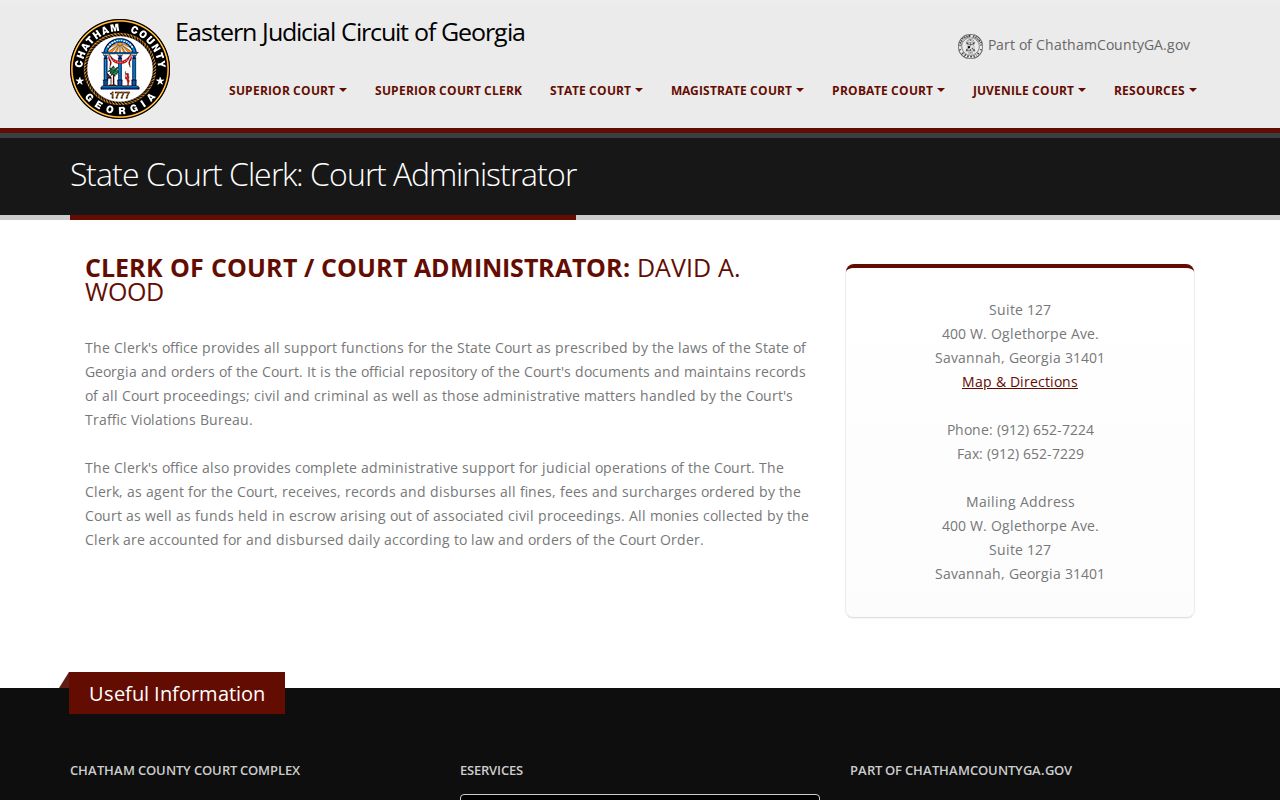
This page helps route a misdemeanor record to the office that maintains it.
Inside a Chatham County Criminal Docket
Think of a public criminal docket as a register of case activity. The header can identify the court, filing date, judicial officer, case type, caption, status, and, when public, the disposition. Below that, the party layer names the roles and counsel. The event register is where the real history lives. It tracks accusations or indictments, service, motions, orders, hearings, pleas, trials, sentencing, probation activity, and dispositions. The header matters too. It can identify the court, filing date, judicial officer, case type, caption, status, and, when public, the disposition.
| Case number | The portal identifier and court location, sometimes paired with a cross-reference. |
|---|---|
| Charges | Offense description, classification, statute, accusation, or indictment when entered. |
| Hearings | Date, time, courtroom, judge, session, and setting type. |
| Events | A chronological list of filings, orders, resets, pleas, and trial activity. |
| Disposition | Public outcome and date, which should be checked against the signed order. |
| Access | A document link may require registered access, clerk approval, and a fee. |
Copy the case number exactly as it appears. No published Chatham source promises one fixed criminal case-number pattern, so take the number straight from the charging paper or the portal. A calendar session code such as CR tells you nothing about format.
Chatham Criminal Docket Transfer Gap
A local case may not show up in State Court right away. Chatham County State Court warns that documents bound over from Recorder's Court or a municipal court can take one to six weeks to arrive. They then need to be entered and receive a State case number. So a missing State result does not mean the charge vanished.
Check the issuing court first. Hold onto the citation or local case number. Confirm whether the matter was sent to State Court, and search again once the transfer window passes. The State criminal office can explain its public lookup channel. The original municipal clerk can confirm the local docket stage. The State Court Criminal Division describes the misdemeanor docket office and its functions.
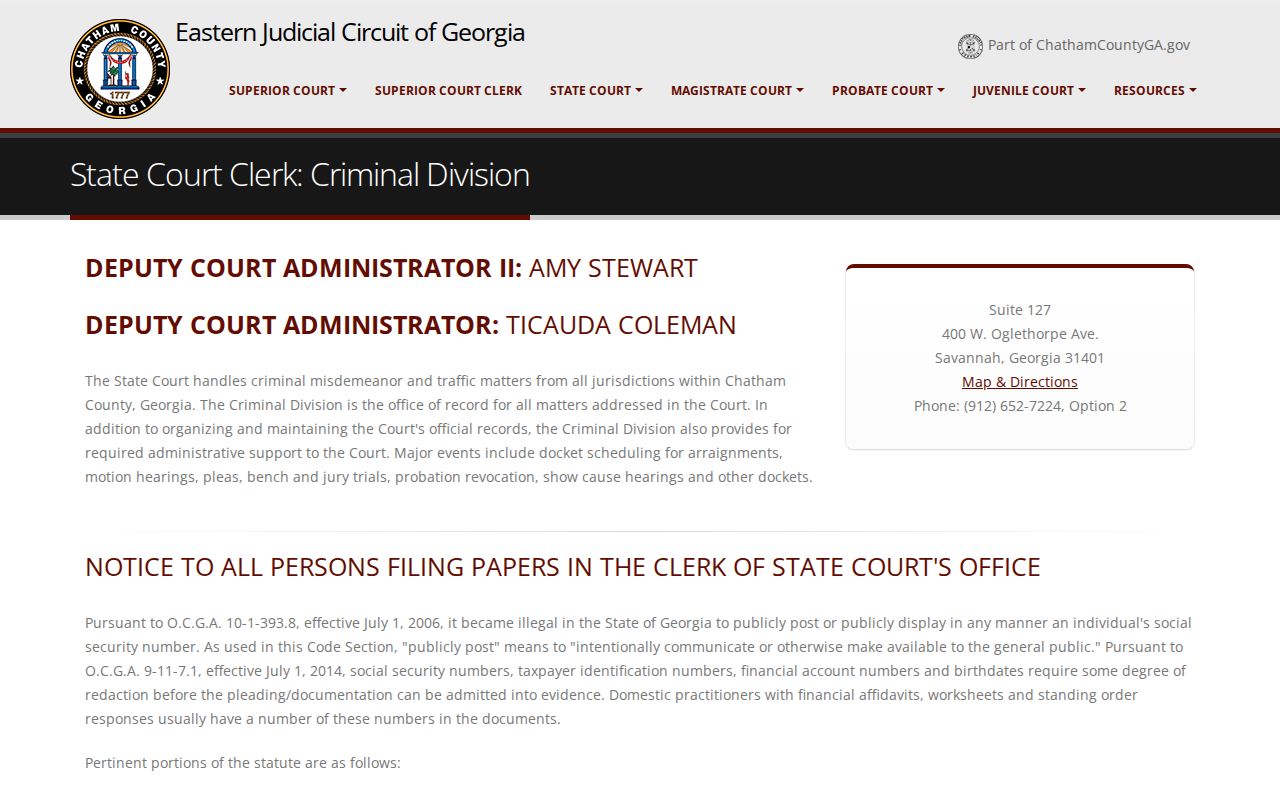
Bound-over files often lag behind the Odyssey search. This division page is the useful fallback while the system catches up.
How a Criminal Case Moves
A criminal docket builds step by step. A Superior case may open with an indictment or accusation. A State case may arrive from a local court. At arraignment, the accused is called to answer the charge. From there, pretrial entries record motions, readiness, discovery-related filings, bond issues, and any change to a setting.
Docket flow: Filing › Arraignment › Pretrial › Plea or Trial › Disposition › Sentencing
Treat that sequence as a reading aid. It is not a promise that every case hits each step. A plea can end the merits before trial ever begins. A nolle prosequi is a prosecutor's dismissal request or order. Probation revocation can add entries long after sentence. The newest signed filing controls more than a short calendar label.
- Arraignment
- The proceeding where the accused answers the charge and scheduling begins.
- Passed
- A calendar note that the matter moved; inspect the latest event for a new date.
- Nolle prosequi
- A prosecutor’s dismissal request or order, not just an absence from the calendar.
- Disposition
- The recorded outcome, best verified through the signed or certified order.
Reading Chatham Criminal Docket Notes
Two views dominate a Chatham County docket search: Court Proceedings and Odyssey Events/Hearings. Court Proceedings faces the date. A session line can carry time and judge. It may also list courtroom or location, attorney, case number, and party label. Odyssey faces the case. Hearings sit inside the full event history.
Read with care. Words like "plea," "passed," and "sentencing" describe what happened on a given day. They are never the signed judgment itself. Start with the newest event, check whether a date was reset, then work backward. For dates across courts, the Chatham County court dates resource covers the calendar channels.
The State Court FAQ walks through TVB, failure to appear, restriction, and disposition questions.
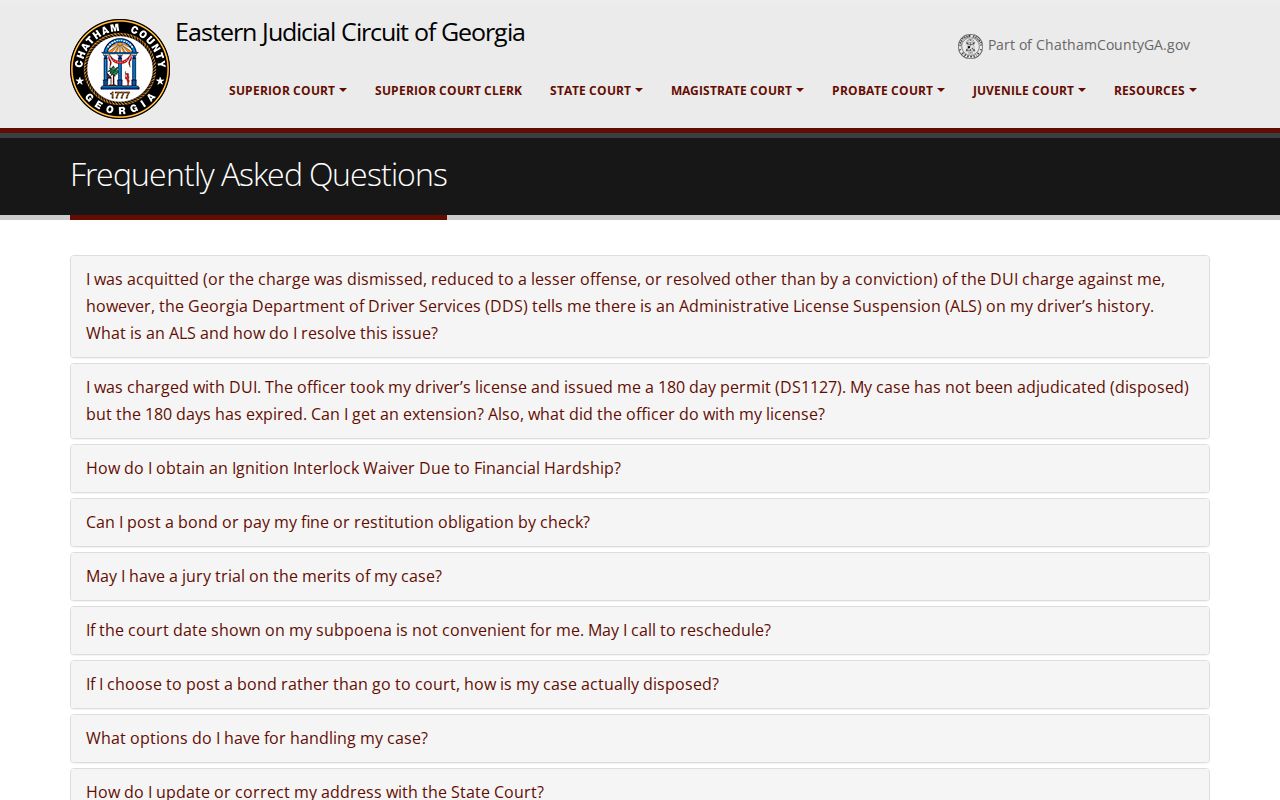
The FAQ adds context that a terse event label alone cannot supply.
Courts That Hold Criminal Dockets
Chatham County criminal dockets live in separate offices. Knowing which court handled the charge saves time. Clerk of Superior Court Tammie Mosley keeps felony files for Superior Court. The office sits at the Gadsden Courthouse, 400 W. Oglethorpe Avenue, Suite 178, Savannah, Georgia 31401. The State Court layer sits elsewhere in the building. David A. Wood, the State Court Clerk and Court Administrator, runs that office from Suite 127 at the same street address. Each office holds its own records.
Requesting a copy from the Superior Criminal Division works in person or by mail. Mail goes to P.O. Box 10227, Savannah, GA 31412, while carrier deliveries use the street address. Fax a request to 912-434-8986. Files stored offsite may need 48 hours before the clerk can produce them. A state transcript needs the clerk's form. It asks for the case number, case name, date and type of proceeding, judge, and the requester's contact details.
Recorder's Court, the municipal courts, and Juvenile Court all stay outside these offices. Check the court named on your citation or charging paper. Not every Savannah-area criminal matter is a Superior case.
Chatham Criminal Docket Dispositions
A free docket view is a finder's tool, nothing more. It can locate a case. It is not the authenticated record. When you must prove a final outcome, ask the proper clerk for the signed disposition or a certified copy. Include the case number and names or case style. Add the document you want, a date range if known, your delivery choice, and contact information. The Superior Clerk Criminal Division page lists the local copy routes and the electronic certification option.
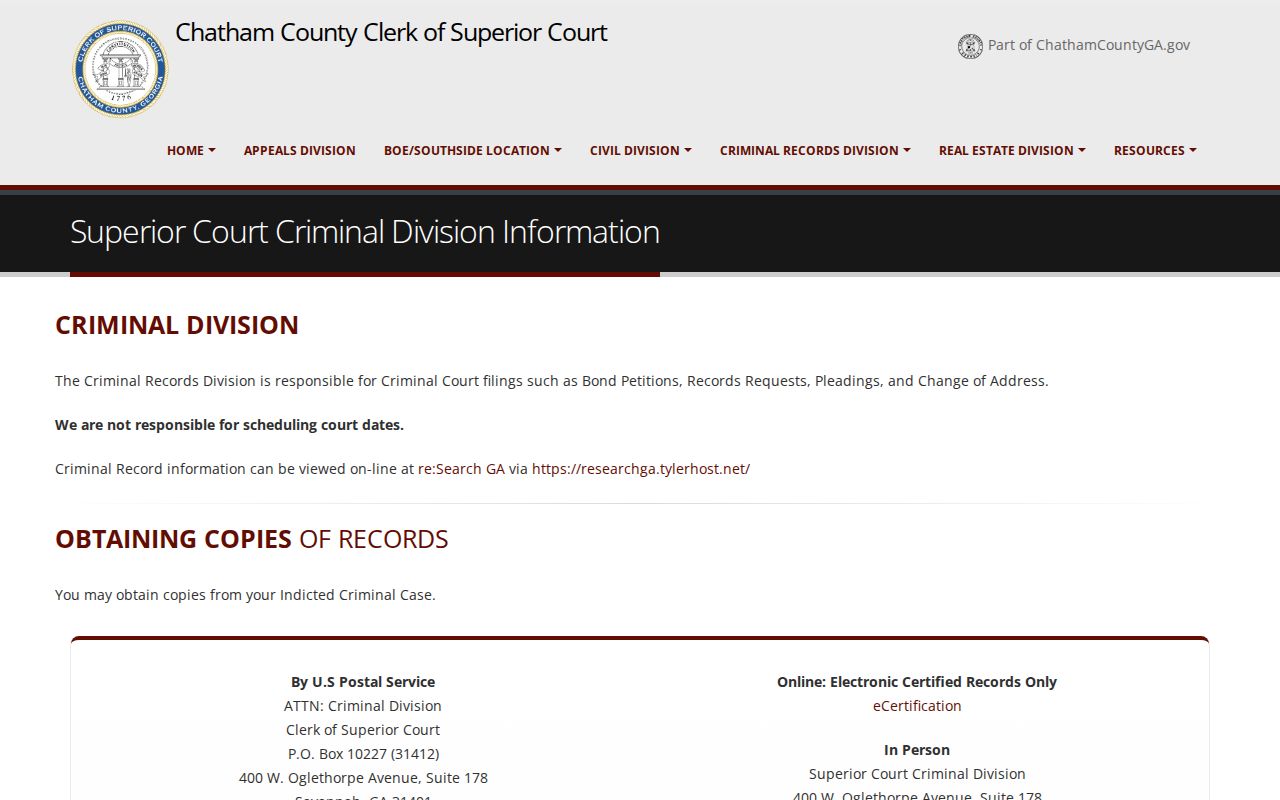
Finding a docket entry is one step. The clerk's own guidance makes clear that pulling the filed image is a separate step after that.
Key point: A calendar note may identify a plea or sentence setting. Only the filed order or certified disposition supplies the clerk-authenticated result.
Sealed Dockets and Public Access
Anonymous public users can usually see nonconfidential Chatham County criminal case metadata. This covers party roles and event headings. It also adds hearing settings and status. Odyssey's anonymous access shows no document images and no sealed or confidential material. Registered access, granted after clerk approval and payment, can expose more document metadata. Registration never overrides a seal, though.
Georgia access rules:
Georgia Open Records Act, O.C.G.A. §50-18-70, supports access to public agency records unless an exemption applies.
Uniform Superior Court Rule 21 generally keeps court records public while providing a process to limit access, seal, or redact them.
O.C.G.A. §35-3-37 governs record restriction. Restriction is a separate process from searching or deleting a docket event.
Juvenile matters take a separate confidential route in Chatham County. Protected identifiers get redacted, and a sealed case may vanish from view or show only limited metadata. If no public result appears, confirm the court and the spelling of the name, allow for a bound-over delay, try another search key, and contact the proper custodian.
Chatham County Criminal Docket Scale
The Georgia Administrative Office of the Courts measures workload for the Eastern Judicial Circuit. The count is not for Chatham County alone. Its 2024 assessment calls this a six-judge circuit. The three-year average runs to 2,835 total criminal defendants. The office reports 1,126 felonies within that criminal mix. It also counts 166 serious felonies and 75 serious traffic cases. Probation revocations reach 1,460. Circuit totals are not a list of Chatham County cases.
These are self-reported circuit workload figures. They are not a current docket count, and they do not count unique people. They still explain something useful. A date list, a case register, and a clerk's file each answer a different question. Any docket search stays tied to one court, one record, and one custodian.